Contents
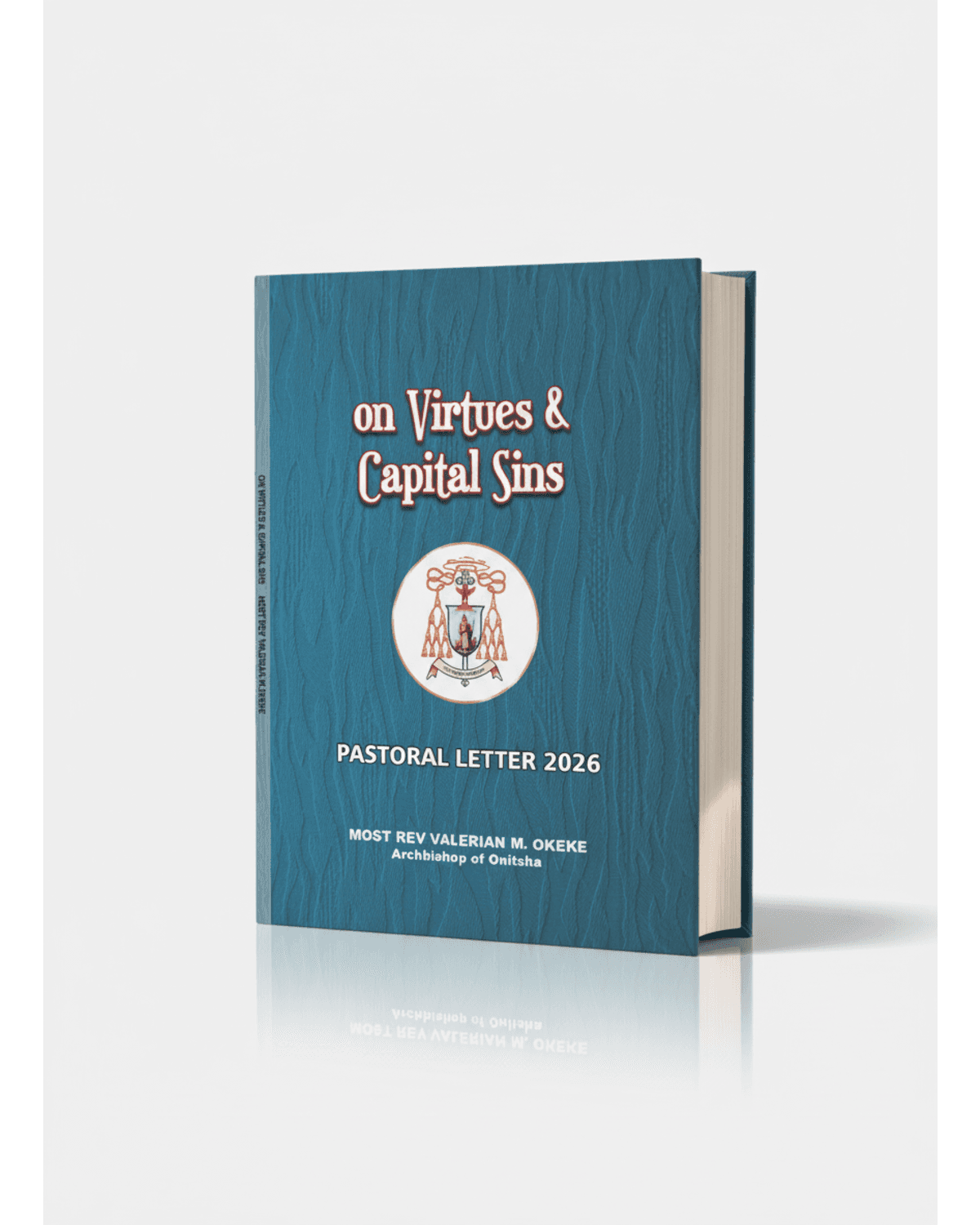
On Virtues and Capital Sins
Joyful Memory and Gratitude
With grateful hearts, we joyfully acknowledge the marvels of the Lord in our midst. As people of faith, we can easily observe and praise the incredible blessings of His loving kindness and care. Reflecting on the past year, we recognise the remarkable progress made in all sectors of the apostolate. While we would not go into details, we cannot overlook the successful completion of the Jubilee Year of Hope with the Universal Church, which has profoundly enriched our lives as individuals and families. We pray that your active participation will foster a spiritual renewal within our families and parishes.
We also celebrated the first-year anniversary of Shanahan University, Onitsha, and welcomed another set of students. Despite challenges with accommodation, we are managing the situation effectively with resilience and grace. The huge number of students is a sign of great promise and blessings.
Furthermore, the celebration of the 140th anniversary of the Catholic faith in our region – the former Eastern Nigeria, along with the hosting of the Apostolic Nuncio, His Excellency, Francis Michael Crotty, and the Irish Ambassador to Nigeria, His Excellency Peter Ryan are moments of grace, reminding us of our spiritual roots and privileged glorious heritage, thereby calling us to renewal of faith and recommitment to the work of spreading the Good News of the Gospel.
In all these, we see the loving Hand of God and can only say, to Him be all glory and never-ending praise forever. Also, the ordination of 44 deacons in commemoration of the great event, stands as a testament to God's abundant grace, and for these, we are profoundly grateful.
We cannot forget that our schools have continued winning laurels in different fields of endeavours. These are evident signs of God's grace which blesses our efforts with fruitfulness. The sustenance and increase in quality and quantity promotes our culture of excellence. Given that excellence is achieved through the life of virtue, it is our intention to discuss virtue which gives the human person the inclination and power to do what is good.
Choice of Topic
As humans, we desire a good society, we desire good friends, good family members, good relatives at all levels, and good companions. It is virtuous life that makes humans good. Without the life of virtue, we can neither have good families nor a good society. Consequently, the dream of a good Church will be an illusion without the life of virtue.
In this pastoral letter, we shall explain the meaning of the term virtue. It is a term with a very long history which was made popular many years before Christ especially by the ancient Greek philosophers. Christianity has elevated virtuous life or Christian perfection as conformity to the image of Christ and the new nature created after the likeness of God. We shall reflect on the four cardinal virtues, namely: Prudence, Justice, Fortitude and Temperance as fundamental natural attitudes that define a true human being. Together with these four cardinal virtues, we shall consider the three supernatural virtues; Faith, Hope and Charity, which give us the perfect image of a person redeemed and sanctified by Jesus Christ. These seven virtues guarantee the fullness of our humanity in this world and lead us to live in eternity with God in the beatific vision. St. Gregory of Nyssa puts it better as he explains that, "the goal of virtuous life is to become like God."
We shall also explain the meaning of Capital Sins, why they are called deadly or capital sins and the virtues that conquer them. While virtues are excellent characters, good habits or dispositions which help us live well as good human beings, vices or in Christian terminology, sins are bad habits which undermine our moral goodness. They are disruptive and destructive to our characters leading the individual to moral failure. Vices are not mere mistakes or occasional failures but persistent dispositions that characterize the moral identity of a person. The following vices are called Capital Sins; Pride, Greed, Envy, Lust, Gluttony, Anger, and Sloth. These are fertile sources of many sins. We shall also find out practical ways on how to cultivate their virtuous alternatives.
Chapter One: Clarification of Terms
The Notion of Virtue, History and Meaning
The word virtue comes from the Latin word virtus (having its root in vir, that is, man), which primarily means manliness, strength or excellence. It denotes the inner power to act rightly and steadfastly even against obstacles and at a cost of sacrifice. We can define virtue as a good habit that gives humans both the inclination and the power to do readily what is morally good. (cf. K.H. Peschke, Christian Ethics, Vol I, p. 339).
In its earliest Roman context, virtues encompassed qualities expected of a soldier such as physical strength, courage, honour and worthiness of respect. It is also understood as excellence in performing a function particularly a man's capacity for valour and civic duty. In classical Greek thought, the word for virtue is arête which meant excellence of character, and the full realization of one's potential. Over the years, the interpretation of the word virtue has evolved but the basic concept has remained the same. We shall briefly examine some of the prominent schools of thought with regard to virtue.
Socrates on Virtue
- For the Great Philosopher Socrates, virtue is the deepest and most basic propensity of man. In his ethics, Socrates identified virtue with knowledge. For him, if virtue is knowledge, then it can be known and consequently taught. This explains why for Socrates, the greatest injunction is, "man know thyself." According to Socrates, virtue does not stop at mere acquisition of knowledge but the knowledge must guide the whole man, including his will, soul and emotions and necessarily lead the person to good actions. He teaches that no one does wrong knowingly. He believes that no one does evil knowingly rather wrongdoing comes from ignorance. However, this theory cannot stand the test of experience, since the more knowledgeable has often not been the most virtuous.
Plato on Virtue
- The Philosopher Plato provides his account of virtue in two different works, the Protagoras and the Republic. Like Socrates, Plato holds that virtue is knowledge. However, he teaches that there are three components of the human soul: the reason, the appetite and the spirit. Plato further suggests that only through a state of the soul in which reason is ruling and appetite and spirit are in their complying roles, can knowledge of the good, and hence virtue, be acquired.
Aristotle on Virtue
- Aristotle discusses virtue in his Nicomachean Ethics. For him, to be virtuous is to live in accordance with reason. He submits that virtue is doing your function well and it is only reason which can enable man to do well.
St. Augustine on Virtue
- For St Augustine, virtue is defined as "rightly ordered love" (ordo amoris). He explains that to live a life of virtue is to love God, persons and things in the right order such that you do not love what is not to be loved or fail to love what is to be loved. Augustine holds that everything in existence has a degree of goodness but some things are more valuable than others. Virtue therefore is loving each object according to its true value and worth. He then teaches that the greatest love should be for God who is the highest good and must be loved above all else. All virtues, including prudence, temperance, courage, and justice find their meaning and unity in the love of God. For Augustine, sin occurs when we love a lesser good more than God or when we love temporal and passing things as if they were eternal.
St. Thomas Aquinas on Virtue
- St. Thomas Aquinas teaches that virtue is a habit that makes it easier for man to do good and live well. It is a stable, consistent and good habit that disposes a person to act well, leading to human happiness. St. Thomas distinguishes natural or acquired virtues and supernatural or infused virtues. Both integrate our natural abilities with God's grace making it possible for man to live a life that is humanly good and divinely oriented.
Virtue in the Scriptures
Though the concept of virtue is not dominant in the Scriptures, nevertheless, the Scriptures dedicated a great deal of space to define and emphasize God's standards of behaviour against which all children of God should measure their lives. God calls his saints, "the excellent ones, in whom is all my delight" (Psalm 16:3). The Old Testament did not spend much time on the concept of virtue because it believes that the Ten Commandments have given the standard behaviour expected of every religious Jew. There are however, few books of the Hebrew Bible which extolled the value of virtue. The book of Ruth, extolled Ruth as a woman of virtue or excellent character (Ruth 3:11). The book of Proverbs described the virtuous woman as an ideal woman who is hardworking, wise, strong, compassionate, fears the Lord, brings good to the family and earns respect (Prov. 31:10-31). The book of Wisdom is full of praise for one who acts with moderation and practical wisdom (Wisdom 8:7).
The New Testament however presents the two Greek words rendered into English as virtue. The first is arête which means excellence or valour (2 Peter 1:5; Phil 4:8). The second is dunamis which refers to the remarkable and miraculous power of God (Mark 5:30; Luke 6:19). The New Testament presents virtue as a gold standard of excellence which all human beings should aspire to and revere. We have several lists of virtues in the New Testament. One of the most quoted is found in Galatians 5:22-23 as the fruits of the Holy Spirit: love, joy, peace, longsuffering, kindness, goodness, faithfulness, gentleness and self-control. In Philippians 4:8, St. Paul urges Christians to embrace the life of virtue. In fact, the Bible serves as a roadmap to a virtuous life.
Virtue in the Catechism of the Catholic Church
The Catechism of the Catholic Church teaches that "virtue is a habitual and firm disposition to do good. It allows the person not only to perform good acts but to give the best of themselves. With all their sensitive and spiritual energies, the virtuous person strives for the good, they seek it and choose it in concrete actions" (CCC, no. 1803).
In simple terms, we can define virtue as a good habit which gives the human person both the inclination and the power to always do what is morally good. Virtue perfects the whole person and makes him good.
The Notion of Capital Sins
We can define sin as a morally bad action. Any action which disregards the obligations of the moral law and the commands of one's conscience is sin. Sin can also be described as disobedience against God's will and an offense against him.
Sin is bad habit. It is virtus (power) turned to evil. As good habit is virtue, bad habit is vice. Any habit, good or bad, becomes a second nature by repetition. However, the Christian moral tradition from the time of the Fathers of the Church recognizes certain vices not merely as individual failings but as capital or deadly sins, those foundational disorders of the soul from which countless others arise. The term capital comes from the Latin, caput, capitis, meaning "head", signifying that these vices serve as the heads from where so many other sins branch off. In other words, they are root causes from which other sins and moral deformities spring (cf. Thomas Aquinas, Summa Theologiae, I-II, q. 84, a.3).
They are called deadly not because they destroy life in a physical sense, but because they corrode the spiritual vitality of the soul and sever communion with God, who is the source of all life (cf. CCC, no. 1866). In a later chapter, we shall discuss in more details the seven Capital Sins; Pride, Greed, Envy, Lust, Gluttony, Anger and Sloth. These bad habits can also be overcome by sincere efforts, prayer and the grace of God.
Chapter Two: The Cardinal Virtues
- The Cardinal Virtues are natural virtues which give man the power and impulse to do right moral actions. They can be strengthened by natural acts and can be acquired by practice. They are Prudence, Justice, Fortitude and Temperance. The term "cardinal" originates from the Latin word cardo, cardinis, which means "hinge". It is so called because human actions hinge on these virtues and they serve as the pivots upon which all moral excellence turns (CCC, no. 1805). In fact, when our actions are governed by these virtues, they become good. The four cardinal virtues: prudence, justice, fortitude and temperance stand at the foundation of moral life. And they are rightly so designated because they respond and correspond to the four faculties in the human person that moderate moral activities. These faculties include: reason, will, irascible appetite, and concupiscible appetite. Human actions are harmonised by these faculties so that one desired virtuous act might not undermine another. Christian Moral Theology teaches that when these natural virtues are perfected by infusion of grace, they become instruments through which the believer cooperates with God's redemptive work. We shall now reflect on these four Cardinal Virtues: Prudence, Justice, Fortitude and Temperance.
The Virtue of Prudence
- Prudence is the virtue which disposes man to discern the mean of every virtue and inclines him to choose the right means of action. It directs the acts of the moral virtues such that it is called the queen of virtues or the coach man of other virtues. Prudence is also called the driver of the virtues, for it guides human action by discerning what is good and choosing the appropriate means to achieve it. (cf. Thomas Aquinas S. Th. II-II, q. 47. a. 1). In Aristotle's ethics, prudence (phronesis) is the practical wisdom which allows one to act according to reason. St. Thomas Aquinas goes further by presenting prudence as the virtue that perfects the practical reason, directing it to the good, applying right reason to moral action in light of divine truth. Prudence enables the conscience to judge rightly, balancing moral principles with concrete circumstances.
How Does One Cultivate and Grow in the Virtue of Prudence?
- This can be done by deliberation, judgment, prayer, meditation and decisive action.
Deliberation involves seeking relevant and reliable information, humility in considering the opinions of others and seeking knowledge from experts and people with more experience.
Judgment means making decisions based on facts and reality not based on emotions or presumptions.
Prayer helps us gain wisdom from God who is the ultimate wisdom.
Meditation fosters inner calmness, enhances self-awareness and provides mental clarity for sound judgment.
Decisive Action involves practical decision and action after prudent judgment.
The Virtue of Justice
Justice is the moral virtue which inclines one to give to others what is due to them as of right. It is the steady and firm will to give each person his or her due (cf. CCC, no. 1807). For St Thomas Aquinas, justice reflects the divine order itself, where love of neighbour becomes a participation in God's righteousness. Justice orders the heart outwardly, it moves beyond private good towards the common good, compelling Christians and people of goodwill to act with fairness, honesty and respect for human dignity.
How Can We Cultivate the Virtue of Justice?
Make sure your words and actions are fair to others.
Be kind to the marginalized and the oppressed. Do not be an oppressor.
Make choices that reflect integrity and uprightness.
Pray God to sustain your good intentions and give you the grace always to act with justice.
The Virtue of Fortitude
- Fortitude is that moral virtue which inclines one to face courageously all grave dangers, including the danger of death. It also prevents one from giving way to fear and recklessness. Fortitude strengthens the will to endure difficulties and remain steadfast in the pursuit of the good (cf. CCC, no. 1808). It moderates fear and recklessness, inspiring courage in the face of trials. In the Christian tradition, fortitude transcends heroism. It becomes a share in Christ's own perseverance in suffering. The Catechism of the Catholic Church defines fortitude as "the moral virtue that ensures firmness in difficulties and constancy in the pursuit of the good" (CCC, no. 1808).
How Can We Cultivate the Virtue of Fortitude?
- We can cultivate and grow in the virtue of fortitude through prayer, through patience in suffering, through imitation of as well as invocation of Jesus and Mary, and through openness to the inspirations of the Holy Spirit.
The Virtue of Temperance
- "Temperance is the moral virtue which moderates the attraction of pleasures and provides balance in the use of created goods. It ensures the will's mastery over instincts and keeps desires within the limits of what is honourable" (CCC, no. 1809). Temperance moderates desire, ensuring that pleasure serves, rather than rules the human person. We can therefore say that temperance is the moral virtue which moderates in the human person, the inordinate desire for sensible pleasures, keeping it within the limits of right reason and faith. Temperance brings inner harmony, forming the person to delight in what is truly good and freeing him from being a slave to excess. The Latin word Temperantia means moderation or self-control.
How Can We Cultivate and Grow in the Virtue of Temperance?
- We can grow in this virtue by a firm resolve to be moderate in food, drinks and pleasures. Learn to say no to unnecessary pleasure and always choose to do what is good and right. When your good intention is backed up by prayer, then self-control and the virtue of temperance will be the outcome.
Chapter Three: The Theological Virtues
While the cardinal virtues are acquired through human efforts and education, through repeated deliberate good acts and perseverance, the theological virtues, that is, faith, hope and charity are infused directly by God. Nevertheless, both orders of virtue cooperate: the theological virtues direct the soul to God as its final end, while the cardinal virtues discipline the faculties of reason, will and passion to act in harmony with divine grace. In this synthesis, St. Thomas Aquinas envisions a moral life where nature and grace converge, that is, human virtue becoming the groundwork upon which supernatural love is built (cf. John Paul II, Veritatis Splendor, no. 37).
According to the Catechism of the Catholic Church, the human virtues are rooted in the theological virtues, which adapt man's faculties for participation in the divine nature (CCC, no. 1812). The theological virtues are the foundation of Christian moral activity; they animate it and give it its special character. They inform and give life to all moral virtues (CCC, no. 1813). We shall reflect on the Theological Virtues: Faith, Hope and Charity.
The Virtue of Faith
Faith is the theological virtue by which we believe in God and believe all that he has said and revealed to us, and that Holy Church proposes for our belief, because God is truth itself (CCC, no. 1814). The Bible teaches us that, "Faith is the assurance of things hoped for, the conviction of things yet unseen" (Heb. 11:1). The virtue of faith is the first of the supernatural virtues. It is supernatural both because it deals directly with our relationship with God, and because we can have it only by sanctifying grace. Faith is the heart of the Christian message and our response to God's invitation. With faith, Abraham, Moses, Samuel, the Blessed Virgin Mary and the prophets responded to God's invitation to serve him in a special way (cf. Gen. 22:1; Ex. 3:4; 1Sam. 3:4; Luke 1:38). The disciple of Christ is expected to keep the faith, live the faith, profess it and bear witness to it (cf. CCC, no. 1816).
We grow in our Christian faith first of all through prayers. We also grow in faith by reading and meditating on the Word of God, the Sacred Scriptures. Again, we grow in faith by mutual encouragement and support from people of faith, also by reading spiritual books, and above all by doing works of charity. Faith without good works is dead according to St. James (James 2:14-17).
The Virtue of Hope
The Catechism of the Catholic Church tells us that "Hope is the theological virtue by which we desire the kingdom of heaven and eternal life as our happiness, placing our trust in Christ's promises and relying not on our own strength, but on the help of the grace of the Holy Spirit" (CCC, no. 1817).
From the above definition of hope, we can say that hope is the answer to the fundamental question of life: what is the purpose of our journey in this life? What is our eternal destiny? These questions are answered by hope. Pope Benedict XVI teaches us that "only when the future is certain as a positive reality does it become possible to live the present as well" (Benedict XVI, Spe Salvi, no. 2). The virtue of hope responds to the aspiration to happiness which God has placed in the heart of every man; it takes up the hopes that inspire men's activities and purifies them so as to order them to the kingdom of heaven (CCC, no. 1818). Pope Benedict XVI assures us that the one who has hope lives differently, the one who has hope has been granted the gift of a new life (Benedict XVI, Spe Salvi, no. 2). From all the above, we can confidently say that Christian hope gives meaning to our present lives as we live in hope of life eternal.
How Can We Sustain the Virtue of Hope?
- The gift of hope as a virtue has to be nurtured and practiced otherwise it will shrivel and die. We can sustain hope by regular participation in the celebration of the Holy Eucharist. The Eucharist reminds us of our incorporation into Christ and nourishes our hope in God and his promises. Again, living a life of gratitude sustains our hope. The life of gratitude always reminds us that life is a gift and a blessing from God. This awareness fills us with hope. The joy of gratitude raises our hope. Finally, we should become ministers of hope. The virtue of hope increases and grows deeper in our lives when we become ministers of hope to others. Hope grows when it is shared. Therefore, Christian hope is both a gift and a vocation.
The Virtue of Charity
The Church teaches us that "Charity is the theological virtue by which we love God above all things for his own sake, and our neighbour as ourselves for the love of God" (CCC, no. 1822). The term charity originates from the Latin word caritas which means affection, love or benevolence. Its meaning has evolved significantly over the centuries particularly influenced by Christian theology. It traces its roots back to the Greek term agape which was understood as the highest form of love. God is love and he who lives in love, lives in God (1 John 4:8). Jesus Christ makes charity the new commandment (cf. John 13:34). By loving his own to the end, he makes manifest the Father's love which he receives. By loving one another, the disciples imitate the love of Jesus which they themselves receive. Whence Jesus says, "As the Father has loved me, so have I loved you; abide in my love." And again; "This is my commandment, that you love one another as I have loved you" (CCC, no. 1823).
St Paul insists that of the three virtues, faith, hope and love, that charity or love is the greatest (1 Cor. 13:13). He teaches that charity is superior to all other virtues and if one has other gifts but lacks charity, then such a person is nothing (cf. 1 Cor. 13:1-4). The practice of all the virtues is animated and inspired by charity which binds everything together in perfect harmony (Col. 3:14). Charity is the source and goal of the practice of all the Christian virtues. It upholds and purifies our human ability to love, and raises it to the supernatural perfection of divine love (cf. CCC, no. 1827).
Charity is divine love poured into our hearts by God through the Holy Spirit. Like any other virtue it grows by practice. To grow in charity, we must avoid sin. To break from God through mortal sin is to break from charity. When well lived and practiced, charity elevates man to a supernatural level beyond ordinary human ability. One who has no charity in his heart can commit all kinds of sins. Such a person can experience torment, anxiety and broken relationships both with God and neighbour. St. Robert Bellarmine says that "Charity is that with which no man is lost and without which no man is saved." The fruits of charity include joy, peace, mercy and happiness. One who loves has the Spirit of God and the fruits of the Holy Spirit are always in him.
To grow in love, it is very important to avoid some sins which are very opposed to the virtue of charity. These include, the sin of indifference which ignores God; the sin of ingratitude which fails to thank God and sees every good in his life as his own making and the sin of hatred for God which leads to pride.
How Can We Grow in Charity?
- We can nourish this gift of God through prayers, through regular participation at Mass and reception of the Holy Eucharist and through the Sacrament of reconciliation. This sacrament of reconciliation heals the wounds caused by sin and nourishes charity by reconciling us with God and the Church.
Chapter Four: The Capital Sins
The Catechism of the Catholic Church teaches us that, "Sin is an offence against reason, truth, and right conscience; it is failure in genuine love for God and neighbour… it wounds the nature of man and injures human solidarity. It is an utterance, a deed or a desire contrary to the eternal law" (CCC. no. 1849).
Virtues are good habits while vices are bad habits. Christian moral tradition recognizes certain vices as capital or deadly sins. They are called "capital" not because they are always necessarily grave, but because they easily become sources of many other sins. They are also called deadly not because they cause physical death but because they are often the first steps in the progress to grave sins.
The term capital is from the Latin word caput meaning "head" signifying that these vices are the root causes from which many other sins and moral deformities arise. They corrode the spiritual vitality of the soul and sever communion with God, who is the source of all life. According to the Catechism of the Catholic Church, vices can be classified according to the virtues they oppose, or also be linked to the capital sins which Christian experience has distinguished, following St. John Cassian and St. Gregory the Great (CCC, no. 1866).
Historically, the list of seven capital sins traces back to the first monk who became a Pope, namely, St. Gregory the Great, (c. 540 – 604). From monastic background, Pope Gregory took the list directly from John Cassian and indirectly from Cassian's teacher, Evagrius Ponticus, who had the original list which was modified by Gregory. So, the list as we have today came from Pope, St. Gregory the Great. If the seven capital sins are not addressed in our spiritual lives, we may find it impossible to break away from other sins which may become habitual. Therefore, if we want to grow in good relationship with God, we need to discover the capital sins and avoid them in our lives. We shall now discuss the seven capital sins: Pride, Greed, Envy, Lust, Gluttony, Anger and Sloth.
Pride
Pride is considered the queen of vices. It is the inordinate exultation of self above others and sometimes above God. It blinds the heart to dependence on grace and breeds contempt for authority and humility. As it is always opposed to humility, it manifests in inordinate desire for honour and independence. In societies, pride can manifest as arrogance, classism, desire for domination and division. Pride is the primordial sin. It was the sin of Lucifer and the sin of our first parents Adam and Eve. God hates pride. The punishment for Lucifer, Adam and Eve, Nebuchadnezzar, Pharoah and Herod bear eloquent testimonies to God's revulsion against pride. Other sins lead the sinner further away from God, but pride attempts to elevate the sinner above God. Therefore, God opposes the proud but gives grace to the humble (James 4:6; 1 Peter 5:5).
Pride is difficult to overcome because it is hard to detect by one filled with the vice. In his arrogance he neither takes correction nor sees anything to correct. Pride makes us want to control everybody, to impose ourselves on them, to dominate them. With pride, we find it difficult to forgive, it makes our will rigid and unbending. Pride leads us to disobedience and insubordination, to contempt and arrogance, and resentment to lawfully constituted authorities. Pride destroys every other virtue in the life of a Christan. At the end however, pride leads to destruction. An Italian proverb says that, "Pride goes on horseback and comes back on foot." The book of Proverb teaches us to avoid pride when it reminds us that, "Pride goes before destruction; the haughty spirit before a fall" (Prov. 16:18).
Can We Have a Remedy for the Vice of Pride?
- We can defeat pride through the practice of humility. A humble man can easily notice the traces of pride in his life and quickly work hard to overcome such. Also, in the battle against pride, every Christian should have Jesus Christ and his Virgin Mother as their model and mentor. We should have recourse to them who, though highly favoured by God remained humble as if they were servants or slaves.
Greed or Avarice
- Avarice or Greed is the excessive desire for wealth or possessions. It is an excessive love for money or any possessions that money can buy. In the Bible, greed is described as covetousness which is forbidden in the Ten Commandments: "Thou shall not covet," (Exodus 20:17). The Lord Jesus condemned this vice when he said; "take care, and be on your guard against all covetousness, for one's life does not consist in the abundance of possessions," (Luke 12:15). The Bible also calls it a form of idolatry (Col. 3:5; Eph. 5:5), that is, worshipping false gods. When greed rules, justice falters and charity grows cold. Greed can lead to an insatiable desire for power, status and influence. Pope Benedict XVI in 2009 described it as the root cause of the global economic crises. Pope Francis all through his pontificate denounced greed as that vice hidden in human beings which drives many wars and conflicts. It is like an addiction leading to compulsive hoarding and pathological accumulation. Greed often breaks the tenth commandment as well as the first when it turns the mind of man to possessions, wealth and power as the highest values to be revered. In the Bible, God's judgment was hard on some greedy people like Gehazi, Prophet Elisha's greedy assistant who was struck with leprosy (2 Kings 5:20-27), the rich man planning for a bigger barn who was called a fool and his life on earth ended (Luke 12:16-21), and Judas Iscariot who committed suicide after betraying his master, mentor and friend due to greed. Greed is deadly and destructive as it gives birth to fighting, quarrelling, lying and even murder (cf. 2 Peter 2:3; Prov. 28:25; James 4:2). "The love of money is the root of all kinds of evils" (1 Tim. 6:10).
Is there Any Remedy for Greed?
- We can overcome greed by generosity. The habit of generosity liberates us from greed and from our slavery to its cravings. The inordinate, disordered desires of greed are also overcome by compassion, kindness and love.
Envy
Envy is sadness over another's happiness, blessings or achievements. It is the bad habit which resents the good of others, a wilful sadness on account of the good of another, whether temporal or spiritual, regarded as diminishing one's own worth. The envious person feels disregarded when another is praised. He would want to see the other person deprived of some goods and is actually happy if and when the goods are lost. This sin is contrary to the virtue of charity. The envious feels unhappy at the fortune of others, he weeps at those who rejoice and rejoices over those who weep. It is dangerous and destructive both for the subject, one who envies and the object of envy. It has a devastating effect on the person who has it as he devours himself inwardly with anger, discontentment and sadness as well as the one who is envied who could be harmed. An example of this is the story of King Saul and David in the book of Samuel (1 Sam. 18: 7-19). Saul wanted to kill David because David was becoming famous.
However, the remedy for the vice of envy is kindness, brotherliness and magnanimity. With kindness we rejoice at the fortunes of others and celebrate their successes.
Lust
Lust is defined as the inordinate desire for sexual pleasure or disordered desire for sexual pleasure detached from love and responsibility (cf. Thomas Aquinas, S.Th IIa IIae, q. 153, a 2). This sin is against the virtue of chastity. Sexual pleasure is morally disordered when sought for itself, isolated from its procreative and unitive purposes (CCC, no. 2351). Sexual feelings are natural and human. God created them as a good gift to humans. Lust is an abuse of sexual instinct. It pulls man away from God, breeds shame and addiction, weakens the power of prayer and meditation. It turns humans into objects of gratification and lowers human dignity.
The virtue of chastity conquers lust and properly orders human sexuality.
Gluttony
Gluttony is the inordinate indulgence in food or drink, or excessive consumption of food or drink driven by an unhealthy desire for pleasure. Gluttony turns a basic human need into an obsession. According to Pope Francis, the ancient Fathers of the Church, gave the vice of gluttony the name "gastrimargia", which translates as, "folly of the belly" (Pope Francis, Catechesis, 10 January, 2024).
Food and drink are very necessary for human existence. They are good as well as needed for survival. But overeating or drinking becomes an abuse. It weakens our spiritual strength and draws us away from God.
We can overcome gluttony by cultivating the virtues of temperance and self-control. Occasional fasting and abstinence as prayer puts an end to the vice of gluttony.
Anger
Anger has been defined as the inordinate inclination to take revenge. It is the intemperate feeling of dislike with the uncontrolled desire for another's punishment.
Anger goes beyond righteous indignation, rather it seeks harm or vengeance and dwells in fury. Anger also called wrath is often rooted in pride and leads to other sins like violence, quarrelling, cursing and even murder. The Catechism of the Catholic Church simply defines anger as "a desire for revenge" (CCC, no. 2302). The uninhibited expression of anger can literally kill, physically, the object, and spiritually, the subject. Jesus connects anger with murder when he said, "you have heard that it was said to those of old, you shall not murder, and whoever murders will be liable to judgment. But I say to you that everyone who is angry with his brother will be liable to judgment" (Matt. 5:21-22). Anger does great harm to oneself and to others. It is one of the serious challenges to growth in holiness. It often has devastating effects on human relationship especially within the family, among friends and between spouses. It can sometimes be transferred to an innocent person. However, as a feeling or passion, anger is not necessarily sinful, as it is often involuntary. It only becomes sinful when we act based on anger. To become angry at an injustice done to someone is not sinful. In the Scriptures, we read about the righteous anger of God in the face of evil and injustice. We can get angry as human beings but should not allow anger to lead us to sin by basing our actions on anger. St. Paul's advice to all Christians is: "Be angry but do not sin" (Eph. 4:26).
The remedy for anger is patience, meekness and forgiveness. Forgiveness helps us let go of vindictiveness and revenge. Jesus is the great example of how to deal with our emotions of anger. He forgave even those who crucified him.
Sloth
The vice of sloth also called acedia is laziness in the wider sense but includes spiritual apathy or refusal to engage with the demands of love or the pursuit of holiness. Sloth turns away from spiritual things because of the efforts which they require. It dulls the conscience and breeds indifference to both God and neighbour. Sloth is not just physical laziness. It is also spiritual laziness, indifference, a deliberate disinterest or aversion to spiritual good, God's love or necessary duties.
In our contemporary world today, we notice this vice, often characterized by a belief that moral responsibility, spiritual efforts and religious discipline are empty burdens, ineffective and archaic demands that cannot lead man forward. Sloth does not just give rise to indolence but above all, it is a breeding ground for despair, boredom, restlessness, sadness and spiritual indifference. It tells a person that his efforts cannot change anything, that the world will remain the same no matter his efforts. It can make one lose the good test of life. According to Pope Francis, "Life loses its significance for those who have developed this vice, prayer becomes boring, and every battle seems meaningless …. It is a little like dying in advance, and it is ugly" (Catechesis, 14 January, 2024). The worst type of sloth is spiritual sloth which is failing to do enough in order to grow in our relationship with God. Every valuable venture demands hard work. Such is our relationship with God which is most valuable. Sloth contradicts the virtues of piety and love of God.
The remedy for sloth is diligence, which is the virtue for a good work ethics. It helps us to put our full minds to the work at hand, while striving to do our best in everything we do. Above all, it is recommended that we pray fervently and lean on Jesus who never abandons those who come to him.
We have seen that the seven capital sins are not theological excavations from medieval sites. Instead, they mirror our contemporary maladies in our present-day societies. The Church's call to repentance and conversion is not merely a summon to personal sanctity but to the healing of the world.
According to the thoughts of the Conciliar Fathers, only when hearts are purified of vice can societies be rebuilt in justice, solidarity and peace. (cf. Vatican II, Gaudium et Spes, no. 25).
Chapter Five: Virtue and Vice in Our Lives
In Adam, we see the old man: the fallen human nature, wounded by pride and enslaved by vice. While, in Christ, we encounter the new man; the redeemed person, restored in grace and made capable of holiness. This is the living drama within every Christian soul. There is a constant struggle between virtue and vice in our lives. Christian moral life encompasses both the avoidance of evil and the cultivation of good. Each capital vice finds its healing not in repression but in the growth of a virtue that reorders the soul towards love of God and neighbour (cf. Thomas Aquinas, S. Th. I-II, q. 71, a.5)
The saints teach us that grace does not only prune vice but replaces it with a habit of holiness. St. Paul exhorts, "Do not be overcome by evil, but overcome evil with good" (cf. Rom. 12:21). There are virtues which have been called capital virtues because they are directly opposed to the deadly sins, but they are distinct from the three theological virtues (Faith, Hope and Charity) and the four cardinal virtues (Prudence, Justice, Fortitude and Temperance). The Capital Virtues, in other words, contrary virtues to the capital sins include: humility, generosity, chastity, meekness, temperance, kindness and diligence. They are contrary virtues to the following capital sins: pride, greed, lust, anger, gluttony, envy and sloth. The capital virtues presuppose the theological and cardinal virtues.
As we have explained in the preceding chapters on vices and their remedies, humility conquers pride, generosity conquers greed, chastity overcomes lust, meekness overcomes anger, temperance overcomes gluttony, kindness conquers envy and diligence puts an end to sloth. This is the way we die to self and live the new life in Christ.
The new life in Christ is the life of virtue. Virtue, in this sense is the quality of cultivated manliness that translates to spiritual maturity rooted in prudence, justice, fortitude and temperance. The virtuous man is not a perfect man but striving towards perfection. He is a disciplined one, whose passions are governed by reason and whose reason is guided by grace. The Church has long spoken of the theological virtues – Faith, Hope and Charity – as divine infusions that orient the soul towards God. Faith illumines the mind, Hope strengthens perseverance and Charity perfects the will in love. These virtues draw man upward, teaching him to see beyond himself and to rest his confidence in God alone. Flowing from them are the four cardinal virtues: Prudence, Justice, Fortitude and Temperance – the hinges upon which moral life turns. Prudence gives right judgment in action, Justice ensures fairness and respect for others, Fortitude grants courage in adversity and Temperance brings balance to desire. Together, they purify the inner character of one who seeks to serve God with integrity. They are the pillars upon which Christian life must stand.
Yet where virtue builds, vice often destroys. Pride seeks to enthrone the self, Greed hungers for possessions, Lust enslaves the heart, Envy endangers the neighbour and Sloth drains the soul of zeal. These are the marks of the old man in us – the Adam or original sin within us, tempting us to live for ourselves rather than for God. Every Christian should die daily to self in order to live the life of virtue. The Christian who refuses this daily dying of self or cultivation of virtue may emerge unconverted.
It is good to know that a disciple without virtue is a man still owned by the old Adam. He may wear the Christian garments, but his heart remains unredeemed. True formation in Christian life means letting Christ conquer every hidden vice in us until only his likeness remains. The world today does not need only more baptized Christians; it needs holy witnesses. It needs men and women of virtue who have allowed the Spirit of God to crucify the old man within them, so that the face of the New Adam, the face of Christ, may shine forth to the glory of God.
Chapter Six: Conclusion
- To be a good Christian, one must strive to practice the virtues habitually. He should also be able to identify and avoid sins habitually. St. Francis de Sales – (a Doctor of the Church) – in his book, Introduction to the Devout Life says that "when we are assailed by some vices, we must as far as possible, embrace the practice of the contrary virtues". We have explained the moral and theological virtues to help us realize that they are the foundation upon which the life of holiness is built. We have also exposed the seven capital sins with their contrary virtues to help us avoid the harms which these deadly sins cause to us and to the human society. This knowledge will help not only to protect us and protect the human family but will also assist us build a good character capable of making us successful in life, both as Christians and as human beings.
This pastoral letter in conclusion insists that though the seven Capital Sins are silent killers of our souls and destiny, they do not have the final word. Through reliance on the grace of God, prayer, cultivation and practice of virtues, we can transform our human weakness into strength and be on the way to holiness and sainthood. By actively practicing the virtues, life becomes a joyful participation in God's goodness.
Prayer
- O God, Strength of those who hope in you, graciously hear our pleas, and, since without you mortal frailty can do nothing, grant us always the help of your grace, that in following your commands we may please you by our resolve and our deeds.
Through our Lord Jesus Christ, your Son, who lives and reigns with you in the unity of the Holy Spirit, God, for ever and ever.
(From the Collect of the Eleventh Sunday in Ordinary Time)
Given in Onitsha, at the Cathedral Basilica of the Most Holy Trinity, on 18th February, Ash Wednesday, in the Year of Our Lord 2026.
MOST REV. VALERIAN M. OKEKE Archbishop of Onitsha